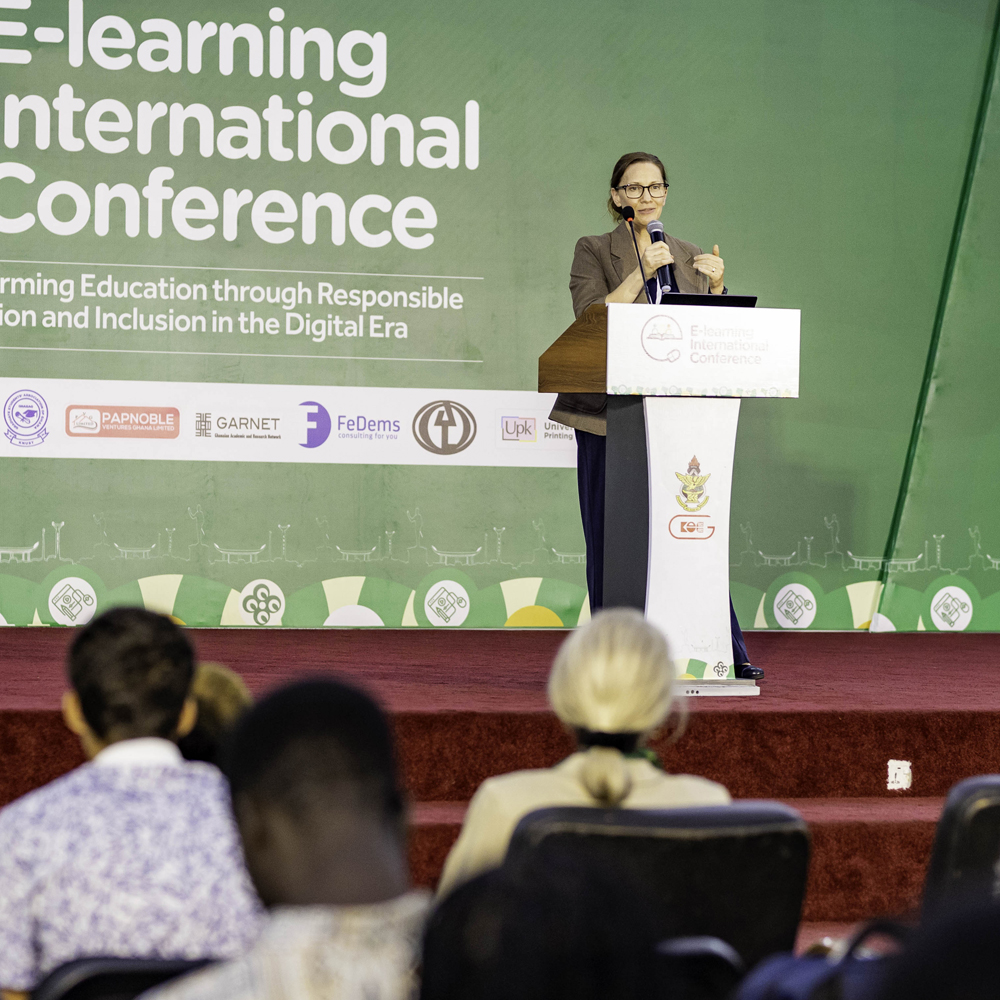


Call for Abstract Submission

Deadline for abstract submission: 5th June 2026
african-american-woman-using-laptop

How to Submit an Abstract

Thank you for your interest in submitting an Abstract. Abstract submission for oral/poster/presentations and hosting workshops as part of the E-Learning International Conference 2026 must be made online using the abstract submission website. Please click the button below to begin.


Submit Abstract

Theme for 2026

Harnessing AI and Emerging Digital Technologies to Advance Inclusive, Equitable and Ethical Learning Ecosystem 

Sub-Themes

  • AI in Education, Governance
  • Digital Equity & Inclusion
  • Pedagogical Innovation
  • Blended learning
  • AI and Emerging technologies for smart agriculture and sustainable natural resource management
  • AI use in assessment and quality assurance
  • Instructional Design and Interactive Learning
  • Micro-credentials & Lifelong Learning
  • Data Privacy and Security in E-Learning
  • Gamification in Education and Training
  • AI-Driven Data Analysis in Virtual Spaces
  • Big Data Technologies for Education and Training
  • Open-Source Virtual Labs in Health, Engineering and Built Environment Training
  • AI in Digital Archiving and Cultural Heritage Preservation
  • Digital Transformation in Art, Built Environment & Social Sciences
  • Automation and Robots for Education and Training
  • Digital Marketing and E-Commerce
  • Any Related Discipline

Important Dates

  • Conference Dates: 16th and 17th July 2026
  • Call duration: 6th May to 5th June 2026
  • Notification of Decision: 12th to 30th June 2026
  • Early-Bird Registration: 15th June to 12th July 2026
  • Publication of Full Papers: 15th September 2026

E-learning-Conf-Website-Important-Dates

General Guidelines

Your submission needs to adhere to the following guidelines

  • The submitting author is required to ensure that all co-authors are aware of the content of the abstract before submission.
  • The submitting author must be listed as the first author.
  • Submitted abstracts should include non-published data.
  • Abstracts previously presented will not be accepted.
  • All abstracts should be presented in clear English with accurate grammar and spelling. If you need help, please seek the assistance of a professional proofreader.
  • Please submit symbols as words.
  • All abstracts accepted for presentation will be published on ELGC’25 website prior to the Conference.
  • You may submit more than 1 abstract. However, only one accepted paper will be allowed for oral presentation.  Additional accepted abstracts will therefore be poster only.
  • Please note the submitting author will receive all correspondence about the abstract.
  • Abstracts may not be edited/updated after final submission. You are welcome to bring an updated abstract onsite with you.
  • The submitting author should input all author details and upload their abstract using the abstract submission form here. Provide title of the abstract, corresponding/submitting author affiliation, email address and phone contact in the submission system.
  • Submitted abstracts must be anonymized for the purposes of blind review.
  • All abstracts will be double-blind reviewed for their educational/theoretical/research merits, adherence to submission guidelines, and link to the conference theme and subthemes
  • The official language of the conference is English.
  • Abstract must be a maximum of 250 words.
  • Each abstract must have a maximum of 6 keywords.
  • Authors of accepted abstracts will need to prepare and submit an extended abstract or a full paper.
  • Each abstract submitted must indicate whether they are submitting for oral presentation, poster presentation or workshop hosting
  • Submissions should use 12 pt font, and follow the formatting guidelines provided below
  • Your abstract is not successfully submitted until you receive a confirmation e-mail after clicking the final submit button. If you do not receive a confirmation e-mail, please contact us.

Guidelines for submission

Before you begin, please prepare the following information:

  • Abstract Topic – abstracts must be allocated to a specific Subtheme or topic. For a complete listing of conference Theme, Sub Themes and Topics, please see above.
  • Presenting author's contact details (should be the same details as the submitting author so that the presenting author receives the correspondence about the abstract)
    • Email address
    • Full postal address
    • Daytime and evening phone number
  • Author and co-authors' details
    • Full first and family name(s)
    • Affiliation details: department, institution / hospital, city, state (if relevant), country
  • Abstract title - limited to 20 words in UPPER CASE
  • Abstract structure – Authors must provide a structured abstract of 150-250 words, which includes:
    • Objectives (A brief problem statement followed by the aim of the study)
    • Methods (Design/methodology/approach used in the research)
    • Results/Findings
    • Practical and social implications (if applicable)
    • Conclusions
    • Keywords - Authors are to include 4-6 keywords for indexing purposes
  • General Formatting
    • File format: Microsoft Word (.docx) or LaTeX (.tex).
    • Times New Roman, 12 pt.
    • One-inch margin on all sides.
    • Double-spaced.

Abstract Submitters' Declaration

During abstract submission you will be asked to declare the following:

  • I confirm that I previewed this abstract and that all information is correct. I accept that the content of this abstract cannot be modified or corrected after final submission and I am aware that it will be published as submitted.
  • Submission of the abstract constitutes the consent of all authors to publication (e.g. Conference website, programs, other promotions, etc.)
  • The Abstract Submitter warrants and represents that no part of the information and content provided by him/her nor the publication of any such Content by the Organizers, on the internet or otherwise infringes any third-party rights, including but not limited to privacy rights and/or intellectual property rights.
  • I confirm that the contact details saved in this system are those of the presenting author, who will be notified about the status of the abstract. The presenting author is responsible for informing the other authors about the status of the abstract.
  • I understand that the presenting author must be a registered participant.
  • The Organizers reserve the right to remove from publication and/or presentation an abstract that does not comply with the above guidelines.
  • I understand that I must select a specific Sub-theme or topic for my abstract allocation.  Although the Technical Committee will work hard to honour this selection, this cannot be guaranteed. The Committee reserves the right to change the Sub-theme or topic under which the abstract was originally submitted.

Conflict of interest & Ethical approval

You will be asked to declare that you have received ethical approval for your study (if relevant), and you will be requested to confirm that you will declare any conflict of interest in your presentation at the conference.

Abstract Selection and Presentation

The Committee will review all submitted abstracts. Notification regarding abstract acceptance and scheduling will be sent to the submitting author.

Please note, if your abstract is accepted for oral presentation, the presenting author will be permitted a maximum of one oral presentation in the program.

Some basic reasons that will cause your abstract to be rejected:

  • Not properly written/not understandable
  • No new information provided
  • Promotional in nature
  • Duplicate of another abstract
  • Lack of originality in the proposed work
  • Not aligning with the theme for the conference

 The five Cs of abstract writing that will enhance your abstract:

  • Completeness: The abstract covers the main aspects of your research/work.
  • Conciseness: The abstract contains no excess words or unnecessary information.
  • Clarity: The abstract is easily readable, well-organized, and free of excessive jargon.
  • Cohesiveness: Different parts of the abstract are properly linked, ensuring logical and coherent flow.
  • Correctness: The language in the abstract is appropriate in terms of grammar and aligns with the register of the chosen field or discipline.

Conference Sessions

The conference features a series of engaging presentations, panel discussions, interactive workshops, and an AI innovation showcase, all led by educators, researchers, and technology experts at the cutting edge of digital learning.

Oral-Presentation-Sessions

Oral Presentation Sessions

Each oral presentation session is organised as a symposium with a Chairperson, presentations on a common topic of interest, and one symposium discussant. Presenters explore research from multiple perspectives, providing a coherent set of papers for discussion. Each presenter is allotted 10 minutes for their presentation, followed by 10 minutes for the discussant and 20 minutes for open discussion. This format encourages substantive scholarly dialogue and peer engagement around a focused theme.

  • 4 presentations per session
  • Chairperson and Discussant
  • 10 minutes per presenter + 20 minutes open discussion
     

Interactive Poster Sessions

Dedicated poster sessions are scheduled throughout the conference programme. Each poster is a graphic presentation of a research study displayed on an A0 board in portrait format. Authors deliver a one-minute oral summary to an assembled audience, after which an in-depth discussion takes place around the poster displays. Poster sessions foster richer, one-on-one interaction and are ideal for early-stage research and visual storytelling of findings.

  • A0 portrait format (0.841m × 1.189m)
  • 1-minute oral summary per poster followed by in-depth discussion
  • 90-minute sessions
Interactive-Poster-Sessions

Workshop-sessions

Workshop sessions

Workshops and demonstrations enable presenters to display, explain, and familiarise participants with an innovative approach, a teaching or research tool, or a learning sequence relevant to e-learning practice. The emphasis is on hands-on engagement rather than critique of completed research. Workshop conveners are expected to allocate adequate time for reflective discussion, and participants are encouraged to share experiences with comparable tools or innovations at the close of the session.

  • Hands-on, learning by doing
  • Brief presentation of completed research permitted
  • 90-minute sessions

AI Innovation Showcase

In alignment with this year’s conference theme, the AI Innovation Showcase is a dedicated session for demonstrating live AI-powered tools, platforms, and applications in educational contexts. Presenters from academia, industry, and edtech organisations are invited to exhibit working solutions that advance inclusion, equity, or ethical practice in digital learning. This session bridges the gap between research and real-world implementation, offering attendees direct exposure to cutting-edge technologies reshaping the future of learning.

  • Live demonstrations of AI-powered tools and platforms
  • 15-minute showcase + open Q&A per presenter
  • Open to academia, industry, and edtech organisations
Interactive-Poster-Sessions